
by Wonsuh Song (Shumei University)
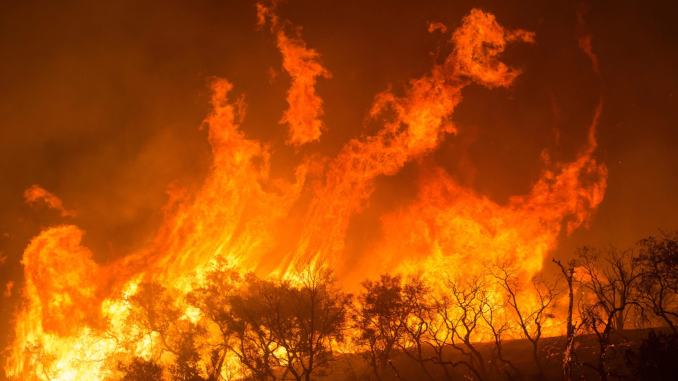
California continues to suffer from devastating wildfires year after year, displacing countless people and destroying homes and livelihoods. The media often attributes these disasters to climate change and Santa Ana winds, but is that the full story? Why is California uniquely prone to such dryness and frequent wildfires? If climate change is a global phenomenon, why are regions like California disproportionately affected? It’s time to ask these critical, often-overlooked questions.
Until recently, these issues were labeled as “global warming.” However, phenomena such as extreme cold spells and freezing winters—contradictory to the warming narrative—led to a shift in terminology to “climate change” or “extreme weather.” Simply changing the terminology does not address the real problems. Instead, it often diverts attention away from the actual causes.
The root cause of California’s wildfire crisis isn’t solely climate change but excessive agricultural activities and water overconsumption. California is one of the largest agricultural hubs in the world, consuming massive amounts of water for farming. This overuse of water has caused rivers to dry up, groundwater depletion, and ground subsidence, creating a far more unstable environment than climate change alone. As a result, California has become increasingly dry and highly susceptible to wildfires.
Adding to this problem is California’s export of water to other states and countries. Instead of addressing its internal water scarcity, the state is losing its precious resources to external markets. Bottling and exporting water have further exacerbated the dire water shortage in California.
Wildfires generate immense heat, creating powerful upward air currents. As hot air ascends, the air near the ground thins, prompting surrounding air to rush in and fill the void. This phenomenon is perceived on the ground as wind, which intensifies in direct correlation with the growth of the wildfire. The infamous “Santa Ana winds” in California would be partially a result of this process. The upward currents caused by wildfires intensify these winds, and the strong winds, in turn, further spread the wildfires. This creates a destructive cycle where wildfires and winds feed into one another, amplifying the devastation. Thus, when media outlets pose the question to experts, “When will this wind subside?” it is, in essence, analogous to asking, “When will this wildfire be fully contained?”
Another critical aspect often overlooked is post-wildfire management. While addressing the immediate fire and its impact on people’s mental health and property compensation is crucial, the ecological aftermath must not be ignored. Forests sprayed with seawater during firefighting efforts undergo significant changes. The salt content in seawater can kill already weakened trees, leaving them more vulnerable to collapse. In such conditions, even a small amount of rain can trigger landslides, creating a secondary disaster following the wildfire.
This raises broader questions: Was it sustainable to allow such excessive farming in an arid region? Was it wise to build homes in fire-prone mountainous areas? For example, during the recent Los Angeles wildfires, my own friends and relatives were forced to evacuate, living in a state of constant anxiety. President-elect Donald Trump’s claim that the Los Angeles wildfires are closely tied to water shortages appears to be a valid observation. Excessive water usage undeniably plays a major role in worsening the problem.
California isn’t the only region suffering from devastating wildfires. Other areas, such as Australia, Brazil, Spain, and Portugal, have faced similar crises. The common thread among these regions is their reliance on large-scale agriculture. Excessive farming leads to water scarcity and ecological disruption, creating an environment where wildfires thrive. Oversimplifying these crises as mere consequences of climate change obscures the root causes.
To address California’s wildfire problem, the following measures must be implemented:
- Restrict agricultural activities: Reduce water usage in farming and limit large-scale agricultural practices.
- Ban water exports and interstate transfers: Prevent the diversion of California’s water resources to other states or countries through stricter regulations.
- Enhance groundwater management: Regulate excessive groundwater extraction and ensure sustainable water resource management.
- Develop post-wildfire recovery plans: Implement measures to restore ecosystems damaged by firefighting efforts and prevent secondary disasters like landslides.
California’s wildfires have left thousands of people homeless, devastated, and hopeless. Misdiagnosing the causes of these disasters does nothing to solve the problem and only deepens the tragedy. By focusing solely on climate change, we fail to address the actual root causes.
If California continues to face water scarcity and wildfires at the current rate, its future will remain grim. The United States must act now to implement urgent measures for managing agricultural practices, water resources, and post-wildfire recovery. Now is the time to break this vicious cycle of destruction.
About the Author
Wonsuh Song (Ph.D.), Geographer
- Full-time Lecturer, Faculty of School Teacher Education, Shumei University
- Adjunct Lecturer, Faculty of Education, Waseda University
- Visiting Researcher, Center for Spatial Information Science, University of Tokyo











Leave a Reply